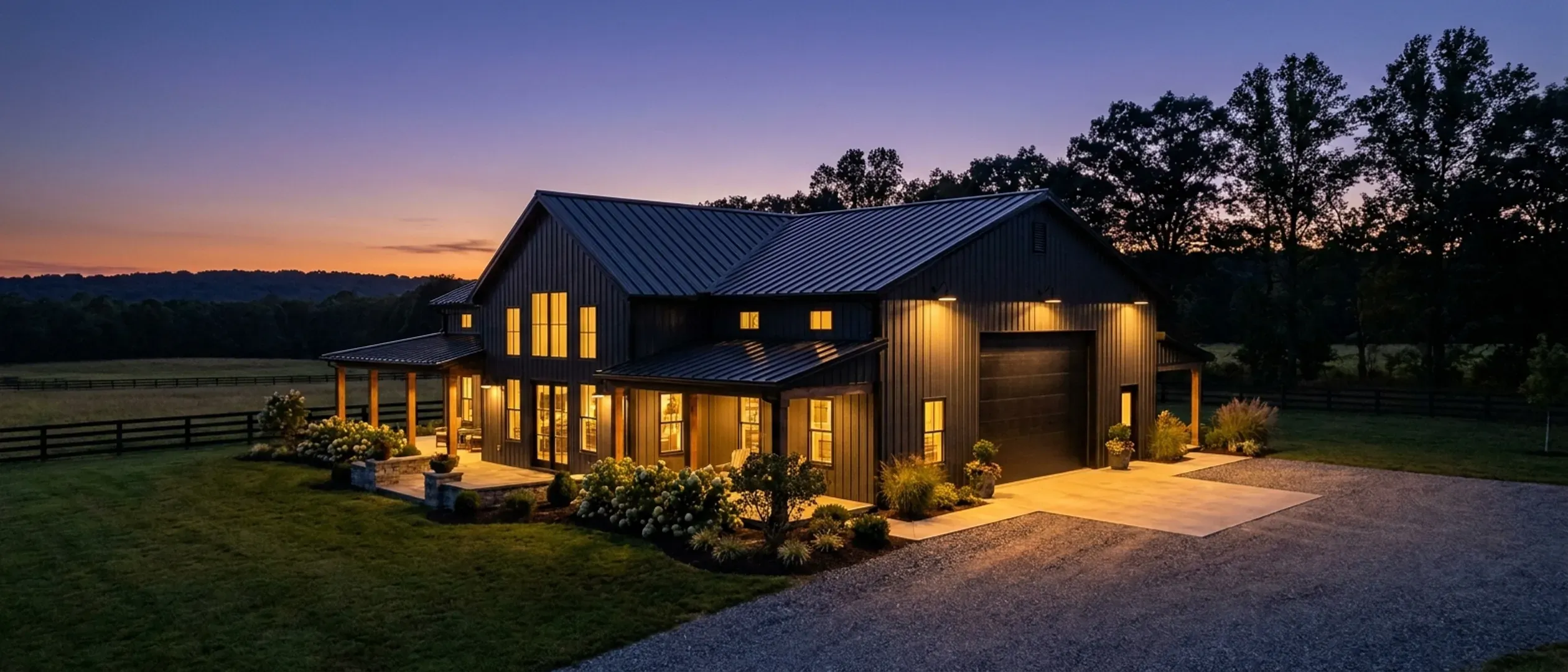
Barndominium Builders in Maryland
We plan and build barndominiums in Maryland on private land, from Frederick and Carroll County to Southern Maryland and the Eastern Shore: barndominium kits, pole barn homes and metal building homes with the shop and the house under one roof. Buy the kit, buy the shell, or hand us the whole project from bare land to keys, with one point of contact from the first drawing to the final walkthrough.
Barndominiums in Maryland: start here
The questions most people bring to us: what can I buy, what does it cost, how do I pay for it, and who builds around Frederick, Waldorf and Baltimore.
Barndominium Kits for Sale in Maryland
What you can actually buy: a steel or pole barn kit, a dried-in shell or a finished build, and how a kit differs from a prefab, modular or manufactured home.
What it costs to build a barndominium in Maryland
Published third-party cost data with every source named, the lines that move a Maryland number (site work, septic, well, permits and fees), and how people pay for it.
Barndominium floor plans
Floor plans to start from, with shop bays, lofts and porches, and custom plans drawn for your land and the way you live.
Barndominium builders in Frederick
Frederick, and the farmland and rural lots of Frederick County and Carroll County.
Barndominium builders in Waldorf
Waldorf and La Plata, and the rural land of Charles, Calvert and St. Mary’s Counties.
Barndominium builders in Baltimore
Baltimore City has little open land. The acreage is in northern Baltimore County, Harford County and Carroll County.
Barndominium builders across Maryland: find your region
From the mountains of Garrett County to the tidal marshes of the Lower Eastern Shore, where your land sits changes who approves the build, which rules apply near the water and what the site work involves. Pick the region your parcel is in.
Central, Western and Southern Maryland
Barndominium country: farmland, rural lots and wooded acreage outside town, with room for a shop bay, a well and a septic system.
Frederick and Westminster, and the farmland and rural lots of Frederick County and Carroll County, north and west of the Baltimore and D.C. suburbs up to the Mason-Dixon Line.
Cities
Counties
Hagerstown and the valley farmland of Washington County, Cumberland, and the mountain land of Allegany County and Garrett County.
Cities
Waldorf and La Plata in Charles County, and the rural land of Charles, Calvert and St. Mary’s Counties between the Potomac and the Chesapeake Bay.
The Eastern Shore
Flat farm country across the Bay, with a lot of tidal shoreline. Where your parcel sits relative to the water shapes what can go on it.
Easton and the farmland of Talbot, Caroline, Queen Anne’s, Kent and Cecil Counties.
Cities
Salisbury and the rural land of Wicomico, Dorchester, Somerset and Worcester Counties.
Cities
Baltimore, Annapolis and the D.C. suburbs
Honestly: there is little or no acreage inside the built-up suburbs. If you live in one, the land is usually further out, and each place page says where.
Baltimore City (its own jurisdiction, separate from Baltimore County), Columbia and Ellicott City are largely built out. The rural land is in northern Baltimore County, western Howard County and Harford County around Bel Air.
Cities
Counties
Silver Spring, Aspen Hill and Germantown are suburbs with very little open land. The rural land is in upper Montgomery County, where zoning in the Agricultural Reserve allows one house per 25 acres, and in southern Prince George’s County; many buyers look to Frederick County instead.
Cities
Counties
Annapolis and Severn are built up. The rural land is in southern Anne Arundel County, much of it near tidal water.
Counties
Found your region? Tell us about the parcel and we will come back with what it can take.
What we build in Maryland
Nine ways to get a barndominium out of your head and onto your land in Maryland, from a barndominium kit you put up yourself to a finished pole barn or steel-frame home we hand you the keys to.
Barndominium Kits
Barndominium kits for sale in Maryland: steel and pole barn shell packages for your land, and how a kit differs from a modular or manufactured home.
Custom Plans
Custom barndominium plans in Maryland: floor plans, 3D views and a permit-ready drawing set built around your land, your shop and your budget.
Pole Barn Homes
Pole barn homes in Maryland: wood post-frame barndominiums built as permitted houses, from shell to finished home, with or without a shop.
Shouses
Shouses in Maryland: a home and a full-size shop under one roof, on a steel or pole barn frame, planned so the shop never crowds the house.
Metal Building Homes
Metal building homes in Maryland: barndominiums with metal roofs and siding, finished inside like any house and planned for Maryland's humid summers.
Steel Construction
Steel barndominium construction in Maryland: red-iron frames designed for your site, erected on engineered foundations and finished as homes.
Turnkey Builds
Turnkey barndominiums in Maryland: land to move-in under one contract, from site work and septic coordination to the finished, inspected home.
Site Preparation
Barndominium site preparation in Maryland: clearing, grading, the drive and building pad, coordinated with the perc test, septic and well approvals.
Permitting & Approvals
Barndominium permits in Maryland: who issues them, what the plan set needs, and how septic, well and shoreline approvals fit around the building permit.
How much does it cost to build a barndominium in Maryland?
We do not publish a price list, because on a Maryland barndominium the land and the approvals move the number more than the floor plan does: the driveway, the pad, how far power has to run, the perc test, the septic system and the well, what the building department asks for and the fees that come with the permit. The cost guide sets out published third-party cost data, every figure with its source, and walks through what pushes a build to the top or bottom of the range.
Know which of these you want? A plan drawn for your land is where it starts.
Land to keys, in four stages
Barndominium projects go wrong early, at zoning, access and site checks, long before anyone pours concrete. Here is the order we work in and why.
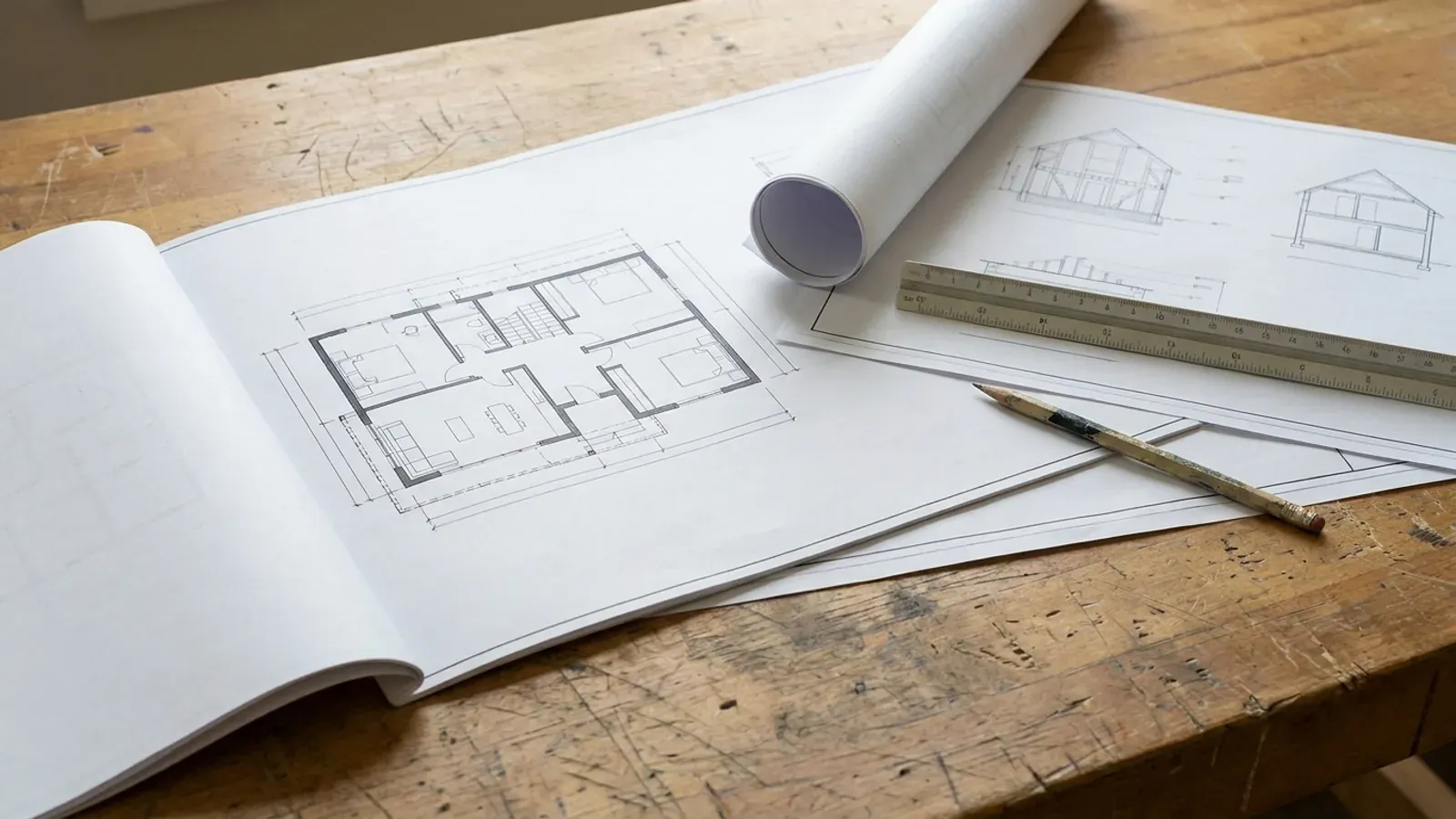
Start your plans
Start the survey. We take your program, the rooms, the shop bay, how you actually want to live in it, and start a floor plan drawn for your land rather than pulled off a shelf, whether you bring a sketch, a saved layout or a blank sheet. This is where most of the useful decisions get made.
That is how a build runs. Step one is a plan drawn for your land, and that starts with the survey.
Building a barndominium in Maryland
Four things shape a Maryland build before anyone pours concrete.
Permits are county-run
Maryland homes are built to the Maryland Building Performance Standards, which adopt the International Residential Code; the state edition in force today is the 2021 code. The Maryland Department of Labor adopts the statewide code, and your county (or, inside some towns, the town) issues the building permit, reviews plans, inspects the work and issues the occupancy certificate. Counties can amend the state code, but they cannot weaken its energy-efficiency, wind-design or home-sprinkler requirements.
How we handle permittingThe Chesapeake Bay Critical Area
Land within 1,000 feet of tidal water or tidal wetlands is usually in the Chesapeake Bay Critical Area. There you face a buffer of at least 100 feet from the water, lot-coverage limits (commonly 15 percent) and, in resource conservation areas, one home per 20 acres. On the Eastern Shore, in Southern Maryland and in Anne Arundel County, check the county’s Critical Area map before you buy; we go through it with you before anything is drawn.
Can you build a barndominium in Maryland?Perc test, septic and well
Before a county will issue a building permit for a home on septic and a well, the health department must issue the septic permit and the well permit. Where the water table rises seasonally, the perc test is run in the wet season. New homes in the Critical Area need a nitrogen-removing (BAT) septic system; outside it a conventional system is allowed unless the county requires BAT. The well is drilled by a Maryland-licensed well driller.
Site preparationHome and shop under one roof
Shop bays, tall doors, equipment and RV storage, guest wings and mudrooms. A shouse puts the living space and a working shop in one new building, planned around how you actually use both, in a pole barn or steel frame.
ShousesBuilding in Maryland: common questions
21 questions we get asked most often about building in Maryland. If yours is not on the list, ask it directly.
Do you build barndominiums across Maryland?
Can I build a barndominium in Baltimore, Columbia or Silver Spring?
Do you build on land I already own?
Are there barndominiums for sale in Maryland, or do I have to build one?
Is a barndominium kit the same as a prefab, modular or manufactured home?
What is the difference between a barndominium, a pole barn home and a metal building home?
How much does it cost to build a barndominium in Maryland?
Is a barndominium cheaper to build than a traditional house?
What is included in a barndominium kit, and what does it leave out?
What size barndominium can I build on my budget?
Can you build a shouse, with living space and a shop under one roof?
Can I finance a barndominium like a normal house?
Do I need a building permit for a barndominium in Maryland?
Does a new barndominium in Maryland need fire sprinklers?
What if my land is near the Chesapeake Bay or a tidal creek?
Will my land need a perc test, a septic system and a well?
Do barndominium plans need an architect or an engineer in Maryland?
Can I put up a barndominium kit myself?
Do you build additions, or a shop next to my existing house?
Who handles plumbing, electrical and HVAC?
How do I get started?
Got land in Maryland? Tell us about it.
Start the survey with your parcel and we will come back with what can be built on it, who has to approve it, and what drives the cost, then a written quote before anything is ordered. No charge for that conversation.