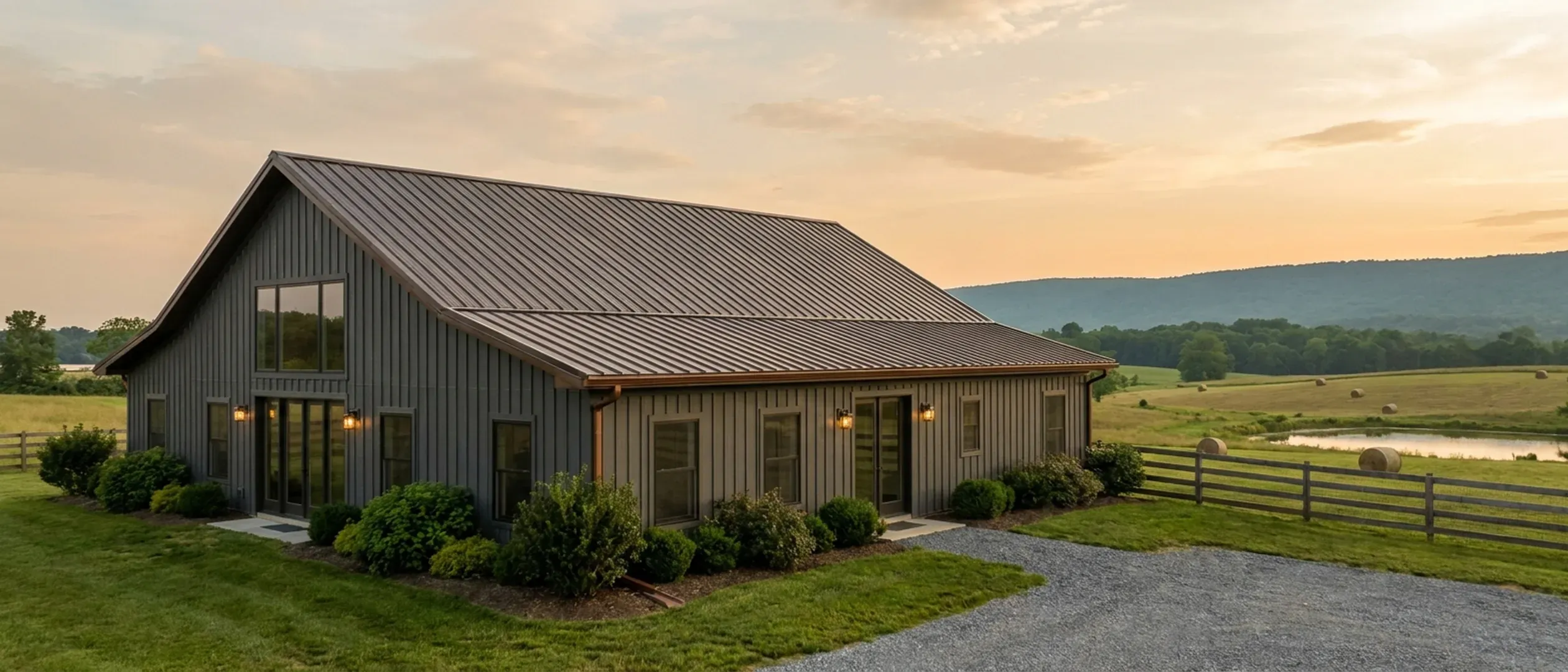
Are Barndominiums Worth It in Maryland?
Whether a barndominium is worth it in Maryland has less to do with the building than with the land under it and what you need the building to do. The structure's real advantages, a clear-span shell and a shop under the same roof as the house, are worth most to people who would otherwise build both. Maryland adds its own questions: finding a lot outside the dense suburbs where the zoning and any covenants allow the building, whether the soils will take a septic system, what the Bay and coastal storms mean for insurance, and how an appraiser values a property with few comparable sales. This page sets out when the answer is usually yes, when it is usually no, and what to check first. It does not quote prices of its own; the cost guide covers what third parties publish.
Figures on this page are cited third-party or government data, not a quote from Maryland Barndominium Builders.
Bottom Line Up Front
- A barndominium is usually worth it when you need the shop or equipment space anyway, you have or can find rural land where it is allowed, and you plan to stay long enough that resale is not the main test.
- It is usually not worth it on a small suburban lot with covenants that control materials, when you may sell within a few years, or when the loan depends on an appraisal that few comparable sales can support.
- Before deciding, get the zoning and covenant answer for the actual lot, the county health department's septic answer, a flood zone determination and an insurance quote on the design, and a lender that has financed one.
When a barndominium is usually worth it
The case is strongest when several of these are true at once.
You need the shop anyway
Equipment, a trade, a boat, horses or a serious hobby. A shouse puts the shop and the house under one roof, on one foundation, with one driveway and one set of utilities.
You want an open plan that can change
With no interior bearing walls, the layout can change as the household does.
You are staying a long time
The value of a barndominium is mostly in using it. The longer you stay, the less the resale question matters.
The land is already right
You own or have found rural land where the zoning allows the house and shop, the soils have passed or can pass a perc test, and the lot is outside the flood hazard area.
When it usually is not
None of these is absolute, but each makes the case weaker.
A small lot in a built-out suburb
Where the lot is small and a homeowners association controls exterior materials, the barn form's advantages mostly disappear and approval may not be possible.
You may sell within a few years
Fewer buyers are looking for a barndominium than for a conventional house, and a short hold leaves little time to recover the premium on a large shop.
The loan depends on a high appraisal
If the numbers only work with an appraisal at or above cost, the lack of comparable sales is a real risk. See barndominium financing.
The shop is bigger than the house needs
A shop adds value only if the next buyer wants one. Size it for how you will use it.
What to check before deciding
Each of these can be answered before you buy land or order a kit.
The zoning and covenant answer for the actual lot
Ask the county (or the incorporated town, where the lot is inside one) whether a house and the shop you want are allowed, and read any recorded covenants and association rules.
The land overlays
Whether the lot is in the Chesapeake Bay Critical Area on the county's map (land within 1,000 feet of tidal water usually is), within a flood hazard area, under an agricultural preservation easement, or large enough to trigger stormwater and forest conservation review. The legal guide explains the Critical Area, easement and forest rules.
Septic and well
The county health department's perc test result, or when the lot can be tested, and the well permit. Both come before a building permit on land without public water and sewer.
An insurance quote on the actual design
Including the wind or hurricane deductible and, near the water, flood insurance.
A lender that has financed one
Ask how it appraises barndominiums and shops before you finalise the design.
Reading this because you are weighing a build? The next step is a plan drawn for your program.
What's different about Maryland
The land decides more than the building
Much of central Maryland between Baltimore and D.C. is built out in subdivisions, and a barndominium with a working shop needs acreage and zoning that allows it. The realistic land is in the rural parts of the counties: the north of Baltimore County, Harford, Carroll and Frederick, Western Maryland, Southern Maryland and the Eastern Shore. The legal guide sets out the rules that decide where a house can go.
Septic soils can decide a rural lot
Where there is no public sewer, the county health department has to approve the soils before a septic permit can be issued. Caroline County's health department says a perc test must be completed before a septic permit can be issued, that tests are held when water levels are highest, generally January to May, and that final determinations take a minimum of three months. A lot that fails, or that can only be tested next spring, changes the whole calculation.
Insurance near the water
The Maryland Insurance Administration's homeowners guide says most standard policies do not cover damage caused by rising waters, and that some policies carry a separate wind or hurricane deductible, sometimes as a percentage of the dwelling coverage. On the Eastern Shore, in Southern Maryland and along the Bay's tidal rivers, those two lines can change the yearly cost of owning the house more than the choice of frame.
Appraisal where comparables are thin
Fannie Mae's Selling Guide accepts unique or nontraditional houses when the appraiser has enough information to reach a reliable value, but notes that rural areas with little sales activity may not have three truly comparable recent sales, and that large barns and similar outbuildings can suggest a property is agricultural. If your loan needs a high appraisal, test that with a lender before you commit.
Covenants in the suburbs
Many subdivisions in the Capital Region and around Baltimore have homeowners associations or recorded covenants that control exterior materials, building size and outbuildings. They apply on top of county zoning, and they are often the real reason a barndominium cannot go on a particular suburban lot.
Climate sets the running costs
NOAA describes Maryland's summers as warm and humid, with far colder winters in the west than in the southeast. A barndominium that is well insulated, air sealed and dehumidified is as comfortable and economical as any house; one that is not will cost more to run and risks condensation behind the metal.
Pros and cons, honestly
Pros
- A shop and a house under one roof and on one foundation.
- A clear-span floor plan that can change later.
- A kit shell can go up faster than a framed house of the same size.
- Tall walls and wide doors for equipment, boats or horses.
- Rural Maryland counties still have acreage where the building fits.
Cons
- Built-out suburbs and covenants rule out many lots.
- Septic soils and the wet-season perc test can delay or stop a rural lot.
- Wind deductibles and flood insurance near the water add to the yearly cost.
- Fewer comparable sales can make appraisal and resale harder.
- A large shop may not add value in proportion to what it cost.
Are barndominiums worth it in Maryland?
Do barndominiums hold their value?
Is it cheaper to build a barndominium than a house in Maryland?
Where in Maryland can I find land for a barndominium?
Does homeowners insurance cover a barndominium in a hurricane or flood?
Can I get a mortgage on a barndominium?
Can an HOA stop me building one?
What should I do before deciding?
Questions answered? Tell us what you want to build and we will put real numbers against it.
Sources
- Fannie Mae Selling Guide B4-1.3-05, Improvements Section of the Appraisal Report — Unique or nontraditional housing; properties with outbuildings; read 27 Sep 2026.
- Fannie Mae Selling Guide B4-1.3-08, Comparable Sales — Rural properties and scarce comparable sales; read 27 Sep 2026.
- Maryland Insurance Administration, A Consumer Guide to Homeowners Insurance — Flood exclusion and wind or hurricane deductibles; read 27 Sep 2026.
- Caroline County Health Department, Septic Systems and Sewage — Perc test before a septic permit, testing window and processing times; read 27 Sep 2026.
- NOAA NESDIS, Maryland and the District of Columbia State Climate Summary 2022 — Humid summers and the west-to-east temperature contrast; read 27 Sep 2026.
Keep reading
The pages that answer the next question this one raises.
Barndominium pros and cons in Maryland
Condensation, storms, covenants, septic and appraisal.
Read itCan you build a barndominium in Maryland?
Permits, zoning, the Critical Area, septic and wells.
Read itBarndominium cost in Maryland
What third parties publish on build costs.
Read itBarndominium financing in Maryland
Construction loans, appraisal and lenders.
Read itShouses
A shop and a house under one roof.
Read itStart the survey
Tell us where your land is and what you want to build.
Read itWant a real number instead of a range?
Start the survey and tell us about your land and what you want to build. Include the county and the tax map and parcel number if you have them, because in Maryland the county, the land-use rules that cover the parcel and the perc, septic and well answers change the budget more than the building does. The survey costs nothing.